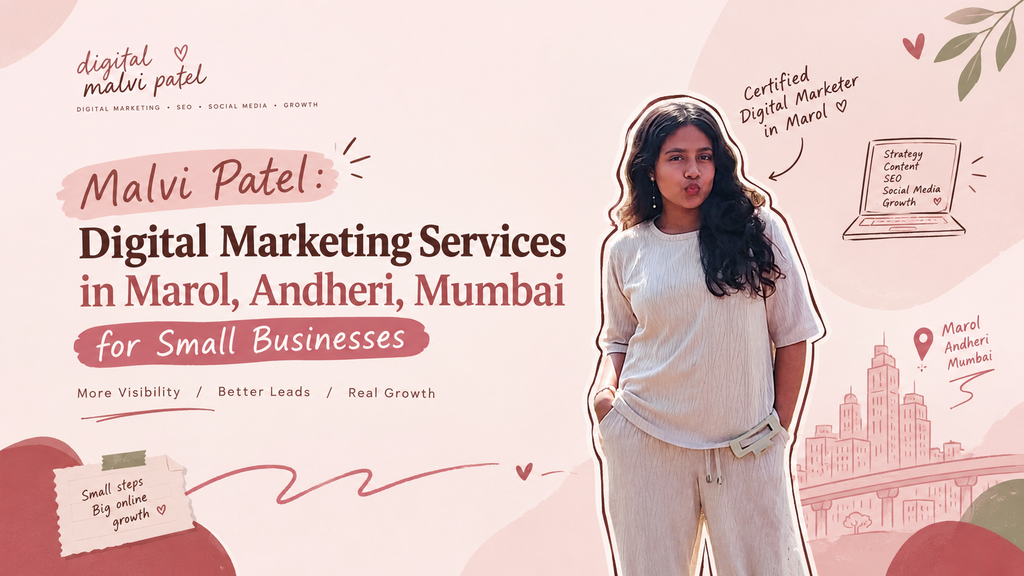
By Malvi Patel | Digital Malvi Patel
Imagine a potential customer searching Google for a product or service your business offers. They find three competitors, compare their websites, scroll through their Instagram pages, read reviews, and make a decision.
But your business? It never enters the picture.
Not because your product is bad. Not because your team lacks expertise. Simply because your brand was not visible at the right moment.
This is a challenge many businesses face today. You may have an excellent product, a reliable team, and years of experience, but if your target audience cannot discover you online, converting potential customers into paying customers becomes more difficult.
This is where a thoughtful digital strategy can make a difference.
I’m Malvi Patel, a certified digital marketer in Marol, Andheri, Mumbai. Through my brand, Digital Malvi Patel, I focus on bringing creativity, search engine optimisation, content, and digital strategy together to help businesses build a stronger online presence.
Whether you run a small business, manage an established company, lead a growing startup, or make strategic decisions as a CEO, understanding how online marketing works can help you make better decisions about your brand’s growth.
In this guide, we will explore the different ways businesses can improve online visibility, connect with their target audience, generate relevant enquiries, and build a digital presence that supports long-term business goals.
What Are Digital Marketing Services and Why Does Your Business Need Them?
Digital marketing refers to promoting a business, product, or service through online channels such as search engines, websites, social media platforms, and digital advertising.
Think of it as the bridge between what your business offers and the people who are actively looking for it.
Digital Marketing Services can include search engine optimisation (SEO), social media marketing, paid advertising, content creation, website optimisation, and other activities designed to help a business reach its target audience online.
However, successful marketing is not about using every available platform. It is about choosing the right channels, understanding customer behaviour, and communicating your value clearly.
For example, a local café may benefit from Instagram content, Google Maps visibility, and customer reviews. A B2B consulting company may need LinkedIn content, search engine visibility, and a professional website that explains its expertise.
Both businesses need marketing, but their strategies should not be identical.
How does digital marketing help a business grow?
A well-planned strategy can support business growth in several ways:
- Greater online visibility: Help potential customers discover your business when searching for relevant products or services.
- Better audience targeting: Reach people whose interests, needs, or professional requirements align with your offering.
- Stronger brand credibility: Build trust through useful content, a professional website, customer reviews, and consistent communication.
- More relevant enquiries: Give potential customers clear reasons and opportunities to contact your business.
- Measurable performance: Track website visits, enquiries, conversions, advertising costs, and other meaningful indicators.
- Long-term discoverability: Build useful website content and search visibility that can continue attracting potential customers over time.
It is important to remember that these outcomes depend on your strategy, competition, budget, offer, and execution. No marketing channel can guarantee sales or first-page rankings.
Why Should Small Businesses Invest in Digital Marketing in Mumbai?
Mumbai is home to businesses across industries, from independent retailers and service providers to established companies, startups, educational institutions, and professional consultants.
With so many brands competing for attention, having a good product or service is only one part of the equation. Customers also need to understand what makes your business relevant to them and why they should consider choosing you.
This is particularly important for businesses operating in Marol, Andheri East, and surrounding areas, where customers may compare several local providers before making a decision.
Consider a simple example.
A business owner offers interior design services in Andheri. Potential clients search online for interior designers near them. If the business has a useful website, relevant service pages, an updated Google Business Profile, and a portfolio showcasing its work, customers have more opportunities to discover and evaluate it.
Now imagine another interior design business with equally good work but very little online information. Customers may struggle to understand its services, experience, or contact details.
The difference is not necessarily the quality of the service. It may be the quality of the online experience.
What are the benefits of online marketing for local businesses?
For local businesses, a strong online presence can help to:
- Appear in relevant local searches.
- Explain services and pricing information where appropriate.
- Showcase products, projects, or customer experiences.
- Answer common questions before customers make contact.
- Build familiarity with people in the surrounding area.
- Provide convenient ways to call, enquire, book, or visit.
As a Digital Marketer In Marol, Andheri, Mumbai, I believe that local relevance should be a meaningful part of the strategy for businesses serving specific neighbourhoods.
Instead of trying to reach everyone, start by understanding who your most valuable customers are, what they search for, and which online channels influence their decisions.
What Digital Marketing Services Should a Small Business Choose First?
One of the most common mistakes businesses make is trying to do everything at once.
They launch a website, create multiple social media accounts, start running advertisements, publish blogs, and experiment with different platforms without establishing a clear priority.
The result? Activity without a consistent direction.
A better approach is to identify the business problem first and select the marketing activities that address it.
1. Search Engine Optimisation (SEO)
SEO helps improve a website’s visibility in organic search results. It involves making your website easier for search engines to understand and more useful for people searching for relevant information.
For example, a company offering accounting services in Andheri may want its website to appear when prospective customers search for accounting services in the area.
A practical SEO strategy may include:
- Keyword research based on customer search intent.
- Helpful, original website content.
- Clear page titles and meta descriptions.
- Relevant headings and internal links.
- Mobile-friendly design and good page performance.
- Technical improvements that help search engines crawl and understand the website.
- Local SEO for businesses serving a defined geographic area.
SEO is particularly valuable when customers actively search for the services you provide. However, rankings take time and depend on competition, website quality, and other factors.
2. Social Media Marketing
Social media gives businesses an opportunity to communicate their personality, share useful information, showcase their work, and build relationships with their audience.
Instagram may suit visually driven businesses such as cafés, fashion brands, salons, and creative studios. LinkedIn may be more appropriate for B2B companies, consultants, recruiters, and professional service providers.
A social media strategy can include:
- Educational posts that answer customer questions.
- Product or service demonstrations.
- Behind-the-scenes content.
- Customer stories and testimonials used with permission.
- Founder insights and industry observations.
- Reels, short-form videos, and visual storytelling.
- Clear calls to action that encourage enquiries.
The goal is not simply to publish more content. It is to publish content that helps the right people understand, remember, and trust your business.
3. Google Ads and Paid Advertising
Paid advertising can help businesses reach relevant audiences through sponsored search results and social media placements.
For instance, a company launching a new service may use Google Ads to reach people searching for that service. An online retailer may use Meta Ads to introduce its products to relevant audiences.
Before investing in advertising, businesses should establish:
- A clearly defined target audience.
- A relevant offer and campaign objective.
- A suitable landing page.
- A realistic budget.
- Conversion tracking wherever possible.
- A process for responding to enquiries promptly.
Paid campaigns can generate visibility quickly, but spending money does not automatically produce profitable customers. Results depend on targeting, competition, the offer, the customer journey, and the effectiveness of the landing page.
4. Content Marketing
Content marketing involves creating useful information that helps people understand a problem, evaluate solutions, or make a more informed decision.
This can include blogs, guides, website copy, videos, social media posts, case studies, and frequently asked questions.
A business selling office furniture, for example, could publish a guide on choosing ergonomic office chairs. The content may attract people researching their options before they are ready to purchase.
Useful content can also support SEO, answer customer questions, and provide material for social media.
The key is to focus on the questions your customers actually ask rather than publishing content simply to fill a calendar.
5. Website Design and Optimisation
Your website often acts as a central point where customers evaluate your business.
A professional website should explain what you do, who you help, what makes your offering relevant, and how visitors can take the next step.
Important elements include:
- Clear service descriptions.
- Simple navigation.
- Mobile-responsive layouts.
- Readable typography and accessible design.
- Relevant calls to action.
- Accurate contact information.
- Useful supporting content.
- Trust signals that are genuine and verifiable.
A website can attract visitors through SEO or advertising, but a confusing website may make those visitors leave without enquiring.
That is why website design and marketing strategy should work together.
How Do You Choose the Right Digital Marketing Strategy for Your Business?
The right strategy depends on your business model, growth stage, target audience, and immediate priorities.
A new business may need brand awareness and a basic online presence. An established business may need stronger organic visibility, better lead quality, or improvements to an existing advertising campaign.
Before selecting channels, ask five questions.
Who are we trying to reach? Define your ideal customers, their needs, location, and buying behaviour.
What business outcome matters most? Decide whether you need awareness, qualified leads, online sales, bookings, or repeat customers.
Where do our customers look for information? Research relevant search terms, platforms, competitors, and customer questions.
What resources can we commit? Consider your budget, internal team, content requirements, and available time.
How will we measure progress? Select metrics that connect marketing activity to business objectives.
For CEOs, managers, and business owners, this process makes marketing decisions more practical. It also helps prevent spending on channels that do not support the company’s immediate priorities.
A strong strategy is not necessarily the one with the most activities. It is the one with a clear purpose, realistic execution, and a process for learning from results.
How Can a Digital Marketer in Marol, Andheri, Mumbai Help Your Business Get More Customers?
Local visibility matters when your customers are searching for services in a particular area.
Imagine a business owner searching for a marketing consultant in Andheri. They may compare websites, check Google Maps, look at social media profiles, and read available reviews before deciding whom to contact.
Your business needs to make that evaluation process easier.
Working with a Digital Marketer In Marol, Andheri, Mumbai can help you develop a strategy around your location, audience, services, and business objectives.
For example, a local service provider may benefit from a combination of local SEO, helpful website content, social media marketing, and targeted advertising. An established B2B company may require a different approach focused on industry-specific search terms, professional content, and lead generation.
At Digital Malvi Patel, the approach is built around the connection between creativity, search visibility, and business goals.
What should you look for when choosing a digital marketer?
Before hiring a marketing professional, consider the following:
- Understanding of your business: They should ask about your customers, services, competitors, and objectives before recommending a strategy.
- Clear communication: You should understand what activities are planned and why they matter.
- Relevant skills: Look for capabilities aligned with your needs, such as SEO, content strategy, social media marketing, or paid advertising.
- Realistic expectations: Be cautious of guaranteed rankings, guaranteed sales, or promises of overnight success.
- Measurement and reporting: Ask how performance will be monitored and how the results will inform future decisions.
- A suitable working approach: Make sure the proposed scope, timelines, and budget fit your business.
The right marketing partner should help you understand your options rather than make the process unnecessarily complicated.
How Does Local SEO Help Businesses in Marol and Andheri Rank on Google?
Local SEO focuses on improving a business’s visibility for searches associated with a particular location.
For example, people may search for a service followed by terms such as “near me,” “in Marol,” or “in Andheri East.”
Google can use several signals to determine which local results are relevant. These include relevance, distance, and prominence.
Although no one can guarantee a particular ranking, businesses can take practical steps to improve their local search presence.
How do I improve my Google Business Profile?
A Google Business Profile helps eligible businesses manage how their information appears across Google Search and Google Maps.
To strengthen your local presence:
- Claim and verify your profile if eligible.
- Choose the most accurate primary business category.
- Provide complete and accurate business information.
- Keep contact details and opening hours updated.
- Add genuine photographs that represent your business.
- Respond professionally to reviews.
- Use relevant features, such as posts, where available.
- Ensure that your website and profile communicate consistent information.
Never add misleading locations or create fake reviews to manipulate rankings. Your business information should accurately represent your actual operations and service area.
How do location-based keywords help local businesses?
Location-based keywords help communicate the geographic relevance of your content.
For example, a service page might naturally include phrases such as:
- Digital marketer in Marol, Andheri, Mumbai.
- Digital marketing consultant in Andheri East.
- SEO services for local businesses in Mumbai.
- Social media marketing for small businesses.
- Online marketing solutions for businesses in Marol.
These phrases should appear only where they make sense. Adding a location keyword to every sentence will make the content repetitive and may harm the reader’s experience.
For local visibility, useful service pages, accurate business information, relevant content, and genuine reputation signals are more meaningful than keyword repetition alone.
How Can SEO Help Your Business Generate Qualified Leads?
Website traffic is useful, but traffic alone does not tell you whether your marketing is helping your business.
Imagine that your website receives 5,000 visitors in a month, but very few people enquire. Another website receives 800 visitors, with a greater proportion of relevant prospective customers contacting the business.
The second website may be creating more valuable opportunities despite having less traffic.
This is why SEO should consider search intent and the customer journey, not just rankings.
What is the difference between website traffic and qualified leads?
Website traffic refers to people visiting your website. A lead is a person or organisation that expresses interest in your offering, for example, by submitting an enquiry or requesting a consultation.
A qualified lead is a prospective customer who meets relevant criteria, such as needing your service, fitting your target market, or having a realistic purchasing requirement.
To attract more relevant leads, consider these steps:
Create specific service pages. Each important service should have a clear explanation of what it includes, who it helps, and what problem it addresses.
Answer customer questions. Publish useful content that addresses pricing considerations, common challenges, comparisons, and the process of working with a provider.
Use clear calls to action. Give visitors a straightforward next step, such as requesting information or contacting your business.
Improve the enquiry experience. Make forms easy to complete and ensure contact information is easy to find.
Measure lead quality. Track not only the number of enquiries but also their relevance and progression through your sales process.
These improvements help connect organic search visibility with the commercial outcomes that matter to business owners.
How Is AI Changing Digital Marketing, GEO and AEO?
People increasingly use AI-powered search experiences and conversational tools to explore topics, compare options, and find answers.
This creates another consideration for businesses: content should be useful not only to people browsing traditional search results but also to systems that retrieve, summarise, or reference information.
Three related terms are worth understanding.
- SEO — Search Engine Optimisation: Improving the visibility and usability of website content in search engines.
- GEO — Generative Engine Optimization: Improving the likelihood that useful, credible information about a brand can be discovered, understood, or referenced by generative AI search experiences.
- AEO — Answer Engine Optimization: Structuring content so it directly answers questions that people ask through search engines and other answer-oriented platforms.
AIO, or AI Optimization, is another term used for efforts to make content and digital information more useful in AI-driven discovery. Its exact meaning can vary depending on the context.
These approaches overlap. They are not separate shortcuts that guarantee visibility in AI-generated answers.
How do I make my website more visible in AI search results?
Start by creating content that clearly explains your expertise, services, and subject matter.
Answer questions directly. Use headings that reflect real customer questions and provide concise, informative answers beneath them.
Demonstrate genuine expertise. Include accurate details, practical examples, original insights, and relevant experience. Avoid inventing client results or credentials.
Keep information consistent. Your website should clearly identify your brand and explain what it does. Where relevant, keep business details consistent across legitimate online profiles.
Use clear content structure. Organise pages with descriptive headings, meaningful internal links, and logical sections.
Maintain a technically accessible website. Ensure important content can be crawled and rendered appropriately, and use structured data where relevant and accurate.
Build trust. Keep information updated, correct factual errors, and provide transparent details about your services.
For example, an article about local marketing can explain what local SEO is, how Google Business Profile works, and what businesses should measure. Such content is more useful than an article that repeats a keyword without offering meaningful information.
No approach can guarantee that a website will be cited by ChatGPT, Google AI Overviews, or another AI system. The objective is to create helpful, clear, trustworthy content that serves users across different discovery channels.
How Much Should a Small Business Spend on Digital Marketing?
There is no single budget that works for every business.
The amount you invest depends on your objectives, competition, target audience, chosen channels, internal resources, and the amount of work required.
A small business building its first website has different needs from an established company running multiple advertising campaigns.
Before allocating a budget, separate your costs into understandable categories:
| Budget category | What it may include |
|---|---|
| Strategy and planning | Audience research, competitor analysis, channel selection |
| Website and SEO | Website improvements, keyword research, content optimisation |
| Social media | Content planning, creative development, account management |
| Paid advertising | Advertising management and the separate media spend |
| Content production | Blog writing, photography, videos, and graphic design |
| Measurement | Analytics setup, conversion tracking, and reporting |
These are categories to consider, not fixed prices or a quotation.
How can businesses market themselves with a limited budget?
If resources are limited, focus on activities that support your most important business objective.
Start by improving your website and business information. Identify the questions potential customers ask and create content that answers them. Choose the social platform most relevant to your audience instead of trying to maintain every platform at once.
You can also review existing marketing activity to identify what is generating relevant enquiries and what is consuming resources without a clear benefit.
A smaller, well-organised marketing plan can be more practical than an ambitious plan your team cannot consistently execute.
How Do You Measure the Success of Digital Marketing Services?
Marketing performance should be measured against the goals established at the beginning of a campaign.
A business focused on brand awareness may prioritise reach and relevant website visits. A business focused on lead generation may pay closer attention to enquiry quality, conversion rates, and cost per lead.
Useful metrics include:
- Organic search visibility: Search impressions, clicks, and relevant keyword performance.
- Website engagement: Visits to important pages and interactions with useful content.
- Lead generation: Enquiry volume, lead quality, and conversion rates.
- Advertising efficiency: Cost per lead, cost per acquisition, and return on ad spend where reliable revenue data is available.
- Social media performance: Relevant reach, saves, shares, profile visits, and enquiries.
- Business outcomes: Sales, bookings, customer acquisition, and repeat business where these can be tracked reliably.
For example, if your goal is to generate enquiries, an increase in followers may be encouraging, but it does not automatically mean the campaign is succeeding.
Similarly, a rise in website traffic is not enough if the visitors are unrelated to your target audience.
The most useful reporting connects marketing activity with business objectives, explains what changed, and identifies what should be tested or improved next.
Why Choose Digital Malvi Patel for Your Digital Marketing Needs?
Every business has its own audience, challenges, and goals. A marketing strategy should reflect those differences instead of relying on the same formula for every brand.
I’m Malvi Patel, a certified digital marketer in Marol, Mumbai, and the person behind Digital Malvi Patel.
My approach brings together creativity and strategy to help businesses build a thoughtful online presence. The services and skills highlighted on my website include social media marketing, search engine optimisation, Google Ads and paid advertising, content strategy and creation, and website-related skills.
The goal is to help businesses communicate more clearly, become easier to discover, and create a more consistent experience for their audiences.
What makes a thoughtful marketing approach important?
I believe good marketing should begin with understanding, not assumptions.
Before deciding what to publish or where to advertise, it is important to understand what a business offers, whom it wants to reach, what customers need, and how success will be measured.
This makes it easier to choose relevant marketing activities and prioritise the work that matters most.
For a business owner, that means having a clearer understanding of why a particular channel is being used. For a manager, it means being able to connect marketing activity with business objectives. For a founder, it means building a brand that communicates its value consistently as the business grows.
If you are exploring Digital Marketing Services for your business, you can learn more about my work and approach on the official website: malvipatel.in.
Frequently Asked Questions About Digital Marketing Services
1. What are digital marketing services?
Digital marketing services are activities that help businesses promote their products or services through online channels. These may include SEO, social media marketing, paid advertising, content creation, website optimisation, and other digital marketing activities.
The right combination depends on the business’s goals, audience, and resources.
2. How do I choose a digital marketer in Marol, Andheri, Mumbai?
Start by identifying your marketing objectives and the skills you need. Review the marketer’s website, understand their approach, discuss the proposed scope, and ask how progress will be measured.
Choose a professional who communicates clearly and sets realistic expectations rather than promising guaranteed rankings or sales.
3. Is SEO better than social media marketing?
Neither is universally better. SEO can help people discover your business when searching for relevant information, while social media can help you build awareness, communicate your brand personality, and engage with your audience.
Many businesses benefit from using both, provided the strategy suits their goals and resources.
4. How long does digital marketing take to show results?
Timelines vary by channel and business. Paid advertising can generate initial traffic or enquiries relatively quickly, while SEO often requires sustained effort before meaningful improvements become visible.
The time required depends on competition, website quality, budget, targeting, and the effectiveness of your offering.
5. Can small businesses benefit from online marketing?
Yes. Online marketing can help small businesses improve discoverability, explain their services, communicate with potential customers, and generate enquiries.
The most practical approach is to prioritise a few relevant channels and measure their contribution to business goals.
6. How can I improve my business’s visibility on Google?
Create helpful website content, improve technical and on-page SEO, maintain accurate business information, and optimise your Google Business Profile if your business is eligible.
For local businesses, relevant location information and genuine customer reviews can also support a stronger online presence. Rankings are not guaranteed.
7. What is the difference between SEO and GEO?
SEO focuses on improving a website’s visibility in search engines. GEO focuses on helping content and brand information become more discoverable and useful in generative AI search experiences.
They overlap in their emphasis on helpful content, clear information, and credibility. Neither guarantees inclusion in AI-generated responses.
8. How much do digital marketing services cost in Mumbai?
Costs vary depending on the services required, project scope, competition, content volume, advertising budget, and level of ongoing support.
Businesses should request a scope that clearly explains the work involved and distinguishes service fees from advertising spend and other expenses.
9. Does every business need a website?
A website is not mandatory for every business, but it can provide a central place to explain your services, publish useful information, showcase your work, and collect enquiries.
The right setup depends on your business model, audience, and the channels through which customers discover you.
10. How can I get started with Digital Malvi Patel?
Visit Digital Malvi Patel to learn more about my background, skills, and approach to digital marketing. You can explore the website and use its contact options to discuss your business requirements.
Final Thoughts: Make Your Business Easier to Find and Harder to Forget
Growing a business online is not about following every new trend or being present on every platform. It is about understanding your audience, communicating your value, and making it easier for potential customers to discover and trust your brand.
For CEOs, business owners, founders, and managers, the best place to begin is with clear objectives. Decide what you want your marketing to achieve, understand where your customers spend their time, and choose the channels that support your business goals.
Search engine optimisation, social media, paid advertising, useful content, and website improvements can each play a role. Their effectiveness depends on how well they work together and how consistently the strategy is reviewed.
As a certified digital marketer in Marol, Andheri, Mumbai, I believe that combining creativity with thoughtful planning can help businesses build an online presence that reflects who they are and what they offer.
At Digital Malvi Patel, the idea is simple: making your brand easier to find, harder to forget.
If you are ready to explore a more thoughtful approach to your online presence, visit malvipatel.in to learn more about my work.
Digital Malvi Patel – Digital Marketer in Marol, Andheri, Mumbai
Contact no. – 9819089771
E mail ID – @digitalmalvipatelgmail@com